
Media Contacts:
Elena Hodges | elena@pangealegal.org
Tania Unzueta | tania@mijente.net
Hannah Lucal | hannah@justfutureslaw.org
June 4, 2026
FOR IMMEDIATE RELEASE
JOINT PRESS RELEASE: Thousands of internal documents expose new details on DHS + ICE use of AI
Yesterday, Just Futures Law, Pangea Legal Services, and Mijente released a trove of internal DHS (Dept. of Homeland Security) documents on ICE (Immigration and Customs Enforcement), CBP (Customs and Border Protection) and other sub-agencies' use of artificial intelligence. Our organizations obtained these documents via a 2024 FOIA lawsuit. Empower LLC provided key research and review of the FOIA documents.
The FOIA documents contain emails, training manuals, and other materials discussing DHS compliance (or noncompliance) with federal rules and policies requiring DHS and other federal agencies to publicly disclose information about their use of AI. The FOIA documents go beyond the public-facing DHS AI Inventory to provide new information about the companies that sell hundreds of AI technologies to DHS, as well as insight into how DHS officials described the impact of their AI on people's rights and safety.
Click here to access the DHS AI FOIA documents. Below are key takeaways and screenshots from the FOIA documents:
ICE's Hurricane Score algorithm used age, gender, country of origin, and where someone lives to rank their likelihood to "abscond" from the Alternatives to Detention (ATD) surveillance program (See pp. 1-7 here and pp. 50-59 and 119-122 here). Until June 2025 [1], ICE used this algorithm, created by ICE contractor Capgemini, to rank everyone in ATD -- a program with over 180,000 immigrants enrolled today -- with a percentage likelihood of "absconding" from 0-100%. According to the documents, ICE labeled anyone with a score of 23% or higher likelihood of absconding as "likely" or "very likely" to abscond. ICE used the weekly score to help decide whether to subject someone to more intensive surveillance monitoring, or worse, detention. According to ICE, the agency is no longer using the Hurricane Score today.
ICE fed the algorithm a list of variables to assess whether someone is likely to abscond. The variables included the person's gender, age, country of birth, whether they require an interpreter, education level, family status, and more. For example, the FOIA documents stated that living in Billings, MT, Kansas City, MO, or Jacksonville, FL were "highly significant" variables, while living in Richmond, VA, Miami, FL, or Buffalo, NY were "insignificant" variables.
For years, communities have stated that ATD is not an "alternative" to detention -- instead, the program expands ICE's system of punishment targeting immigrants. The FOIA documents reaffirm this, showing that ICE's Hurricane Score used many factors outside of someone's control -- including aspects of identity -- to help decide whether to subject them to increased surveillance.
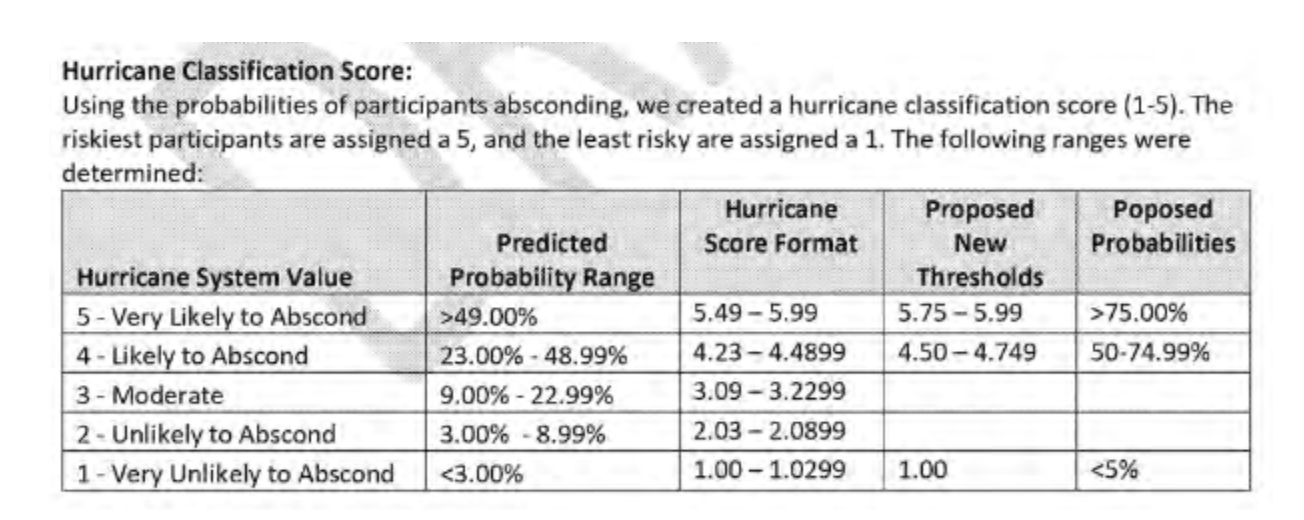
Above: ICE Hurricane Score (See pp. 1-7 here and pp. 50-59 and pp. 119-122 here).
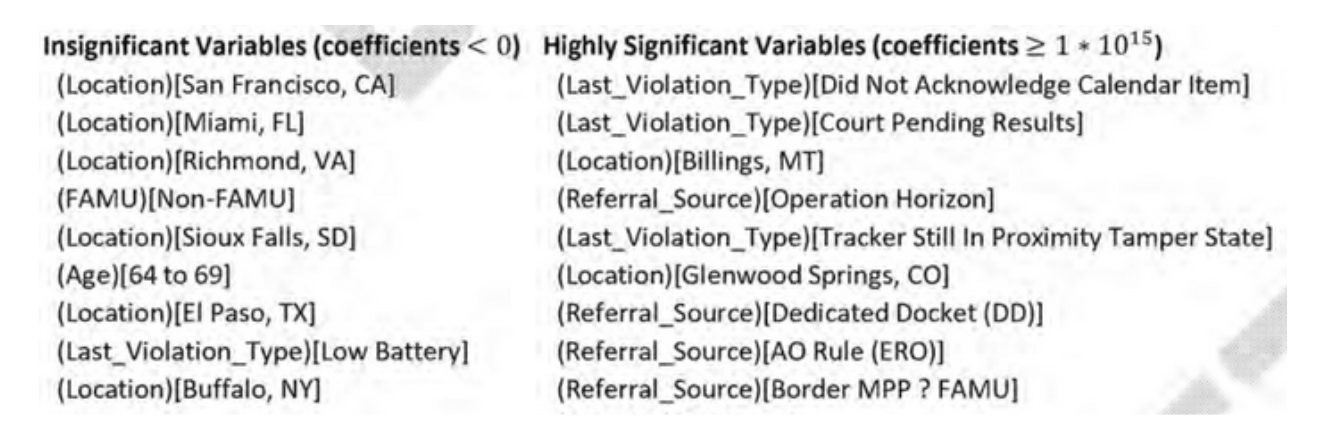
Above: A sample of Hurricane Score variables, weighted as significant or insignificant (See pp. 50-59).
DHS's use of ClearviewAI goes beyond the stated purpose of child exploitation investigations. In the FOIA documents, DHS states that ICE only uses ClearviewAI facial recognition technology for child exploitation investigations (See p. 22 here.) Yet, elsewhere in the documents, DHS also states that ICE HSI's (Homeland Security Investigations) Child Exploitation Investigation Unit (CEIU) can use Clearview for "other" HSI investigations "upon request" and that "other components and offices" may have used ClearviewAI (See p. 1240 here).
DHS approved dozens of face recognition technologies despite inadequate testing (See pp. 73-76 here). In 2024, DHS used facial recognition/face capture technologies in 36 ways across six component agencies, including CBP and ICE. According to DHS, testing & evaluation ("T&E") of technologies is "a key means of validating safe, secure, responsible, and trustworthy use of AI by DHS generally." Yet, DHS described its own testing and evaluation of 35 out of 36 of its face recognition technologies as inadequate. Despite this, DHS still "conditionally" approved their use.
DHS's public-facing AI Inventory likely only shows a sliver of the agency's AI use (See p. 72 here). The public-facing DHS AI Inventory, which does not include "sensitive" or "research & development" use cases of AI, is likely only a small snapshot of DHS's actual use of AI. According to the FOIA documents, DHS keeps a full list of unclassified AI use cases out of public view. As of May 2024, DHS publicly disclosed only 67 out of 278 use cases. For example, DHS publicly disclosed only 9 out of 42 total ways that ICE used AI:
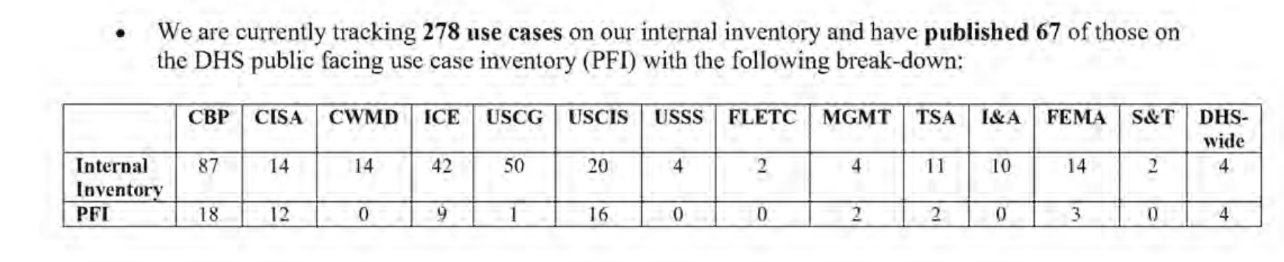
Above: In May 2024, DHS publicly disclosed only 67 out of 278 total uses of AI (See p. 72 here).
You can access the full set of FOIA documents here. To learn about ongoing campaigns and efforts at the intersection of technology/surveillance and immigrant justice, follow our organizations on social media here: Just Futures Law, Mijente, Pangea Legal Services. Stay tuned for ways to get involved!
In solidarity,
JFL, Mijente, Pangea
(1) According to an email from the federal government to JFL in April 2026, ICE's ATD program last generated Hurricane Scores in June 2025.